Two technologies people confuse (and why it matters)
When someone says "we have a bot that answers the phone," they could mean very different things. At one end sits the classic voicebot, better known as an IVR or voice menu: the system that asks you to press 1 for sales, 2 for support, 3 for billing. At the other end sits the AI sales agent, able to hold a real conversation, understand what you ask in your own words, ask follow-up questions and decide the next step.
The confusion is not harmless. Choosing wrong means paying for a tool that does not solve the problem: an IVR will not rescue a sales opportunity that is cooling down, and a sophisticated AI agent is overkill if all you need is to route calls to three departments. The "voicebot vs AI sales agent" comparison is not about tech fashion, it is about the fit between the tool and what actually happens on each call.
In this guide we separate the two worlds without hype: what each one realistically does, how they differ under the hood, why a modern AI agent converses naturally and qualifies leads, and which limits you should keep in mind so you neither idealize the technology nor dismiss it out of prejudice.
What a voicebot or IVR is (and is not)
A traditional voicebot runs on a closed decision tree. It plays recorded or generated messages, offers numbered options, and reacts to what you press on the keypad or, in more advanced versions, to isolated keywords. Its logic is deterministic: if the user presses 2, they go to branch 2. It does not interpret intent, does not reason about context, and does not improvise beyond the script someone programmed.
This has real advantages. An IVR is predictable, cheap to maintain for simple tasks, and perfectly adequate when the goal is to route, share an opening time, confirm an order number, or filter volume before handing off to a human. In highly repetitive, well-bounded processes, a good voice menu is still the sensible choice.
The problem shows up when the conversation steps outside the tree. The customer who says "I'm calling because I'm interested in the plan I saw, but I'm not sure it works for two locations" does not fit into "press 1, 2 or 3." The IVR cannot qualify that opportunity, cannot handle an objection, and cannot adapt its pitch to the caller's profile. In sales, that gap translates into lost leads and the feeling of talking to a machine that does not listen.
Put plainly: a voicebot organizes and routes, but it does not sell. It treats every caller the same, because it cannot tell a browser apart from a buyer ready to move forward.
What an AI sales agent is and how it works under the hood
An AI sales agent starts from a different foundation. Instead of a fixed tree of options, it relies on language models that understand natural speech, keep track of the conversation, and generate responses tailored to each turn. The user does not choose between options: they simply talk, and the agent grasps the intent behind their words, even if they phrase things out of order or switch topics mid-sentence.
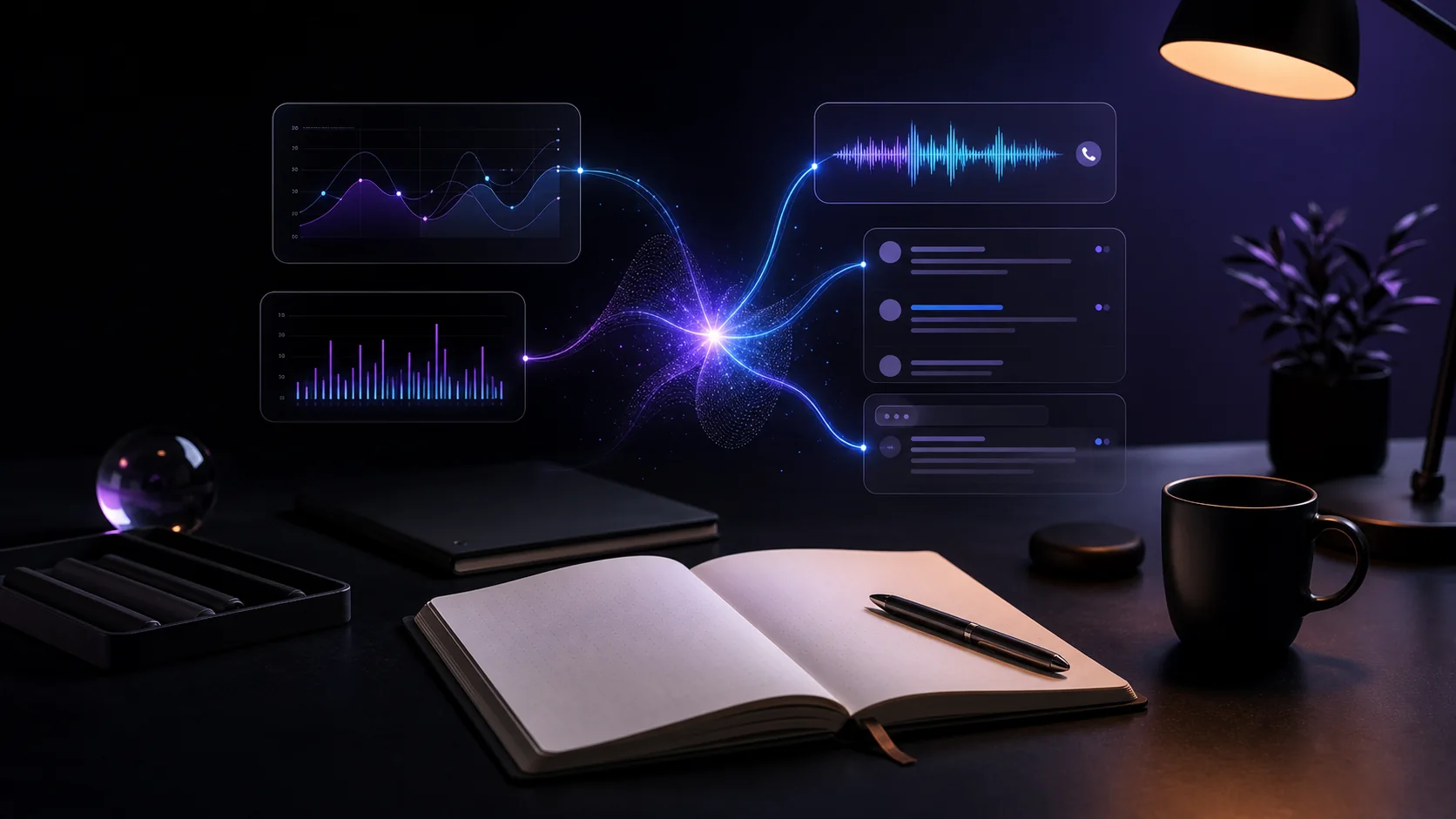
Under the hood it combines several pieces: speech recognition to transcribe what the person says, a language model that interprets and decides what to answer, voice synthesis to reply in a natural tone, and connections to your systems (CRM, calendar, catalog) so it acts for real rather than just chatting. On top of that base you define a concrete sales role: which product it represents, which qualifying questions matter, how to handle objections, and when to book a meeting or hand off to a human.
The practical difference is enormous. A well-configured agent behaves like a sales advisor trained in the client's niche: it knows the talk track, asks the right questions at the right moment, and adjusts its pace to whoever is on the line. Platforms like Vendrava operate precisely at this layer, answering, qualifying and booking leads by voice and WhatsApp, both inbound and outbound, cold calls included, always under human control.
The point is not that it is "smarter" in the abstract, but that it does something the IVR structurally cannot: hold an open conversation and steer it toward a business goal.
Why a modern AI agent qualifies and converses naturally
Qualifying a lead is, at its core, asking the right questions and knowing how to read the answers. An AI agent can detect signals of interest, tell someone just comparing prices apart from someone with a real need, and gather key data (company size, urgency, approximate budget, who makes the decision) without the person feeling they are filling out a form. That information gets structured and sent to the CRM, so the human team receives opportunities ranked by priority, not a list of calls with no context.
The naturalness comes from three combined capabilities. First, it understands open language: it does not need exact words or the customer to "talk like a machine." Second, it keeps memory of the conversation, so it does not repeat questions already answered or lose the thread when the customer wanders. Third, it adapts tone and talk track to context, something impossible in a rigid script.
It also changes availability. An AI agent answers at any hour, replies instantly, and leaves no lead waiting, a decisive factor given that a contact's interest drops fast when no one responds in the first few minutes. In outbound, it makes it possible to work through contact volumes a small team could not cover manually, keeping a consistent pitch on every call.
The result is not to replace the salesperson but to free them up. The agent handles the first layer (reach out, filter, qualify, book) and the human invests their time where it truly counts: in the conversations that are already ripe to close.
Real limits: what you should keep in mind
No AI agent is magic, and presenting it that way leads to disappointment. The first limit is configuration quality: a poorly trained agent, with a weak talk track or no connection to the right systems, performs worse than a simple IVR. The technology amplifies what you give it; it does not compensate for a sales process that does not exist.
The second is supervision. A language model can make mistakes, misinterpret, or give an answer it should not in sensitive cases. That is why human control is not optional: you need to review transcripts, define when the agent should hand off to a person, and set clear limits on what it can and cannot promise. A good rollout treats the agent as another team member who needs oversight, not as autopilot.
The third is regulatory compliance, especially on cold calls and outbound. Before reaching out you must respect the data protection rules applicable in each market, check each country's do-not-call registries, clearly identify who is calling, and offer an easy way out to anyone who does not want to be contacted. These rules vary from country to country, so a compliance-first approach adapted to each jurisdiction is not an extra, it is a condition for operating.
The fourth is about expectations: there are complex, emotional, or highly technical conversations where a human is still irreplaceable. The AI agent excels in the repetitive, filtering stages; fine negotiation and long-term trust remain human territory. Acknowledging that limit is what lets you design a realistic flow instead of an idealized one.
How to decide which one you need
The useful question is not "which is better?" but "what happens on my calls?". If your need is to route, share fixed information, or filter volume with closed options, a well-built IVR does the job and there is no point overpaying. If instead each call is a sales opportunity won or lost depending on how the conversation goes, the voicebot falls short and the AI sales agent is what moves the needle.
Many businesses end up combining both: a first automatic filter for the trivial and an AI agent for the conversations where there is buying intent. The key is not to confuse the layers or expect one technology to do the other's job. A voice menu will never qualify a lead; an AI agent is a waste just to read out an opening time.
Before signing up, demand clarity on three things: what exactly the system does (route, or converse and qualify), how it integrates with your CRM and calendar, and what human and compliance controls it includes. With those answers on the table, the choice between a voicebot and an AI sales agent stops being a marketing question and becomes what it should be: a decision about fit with your real process.